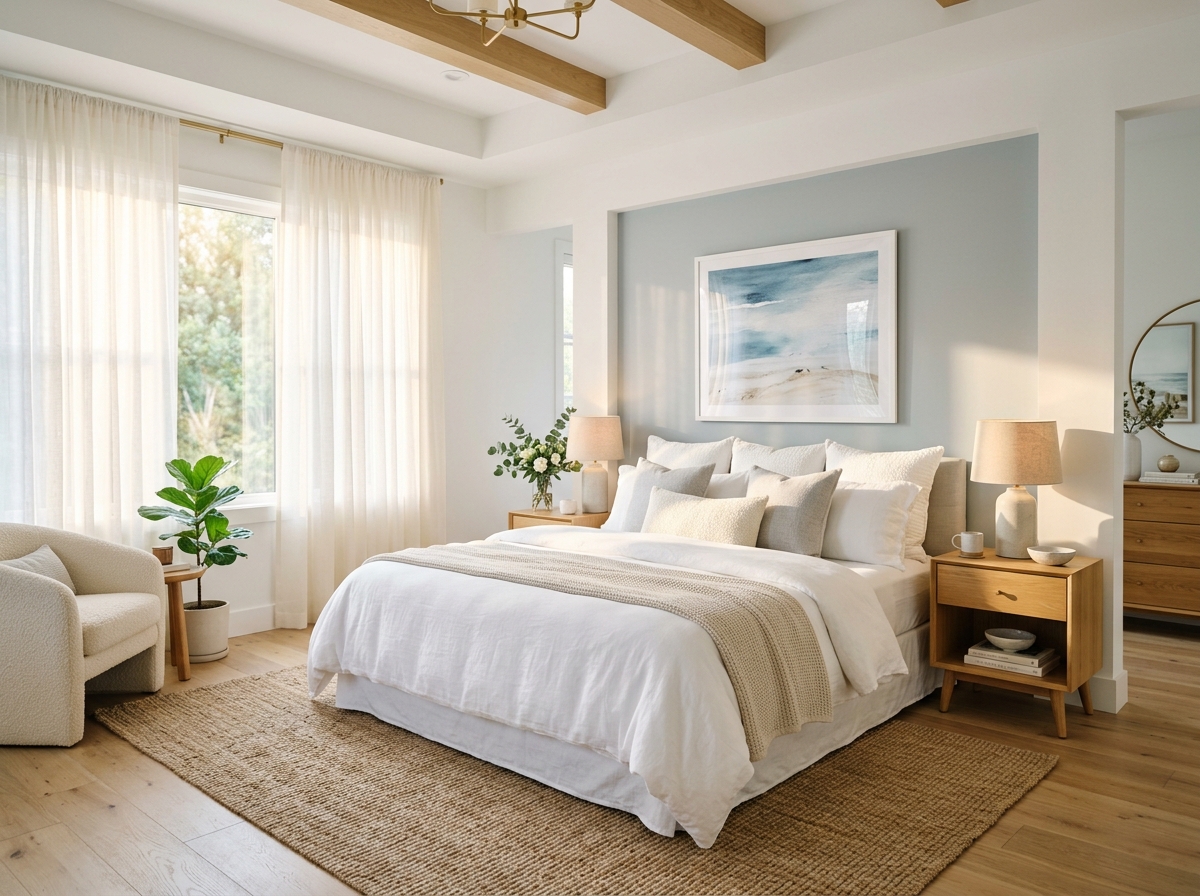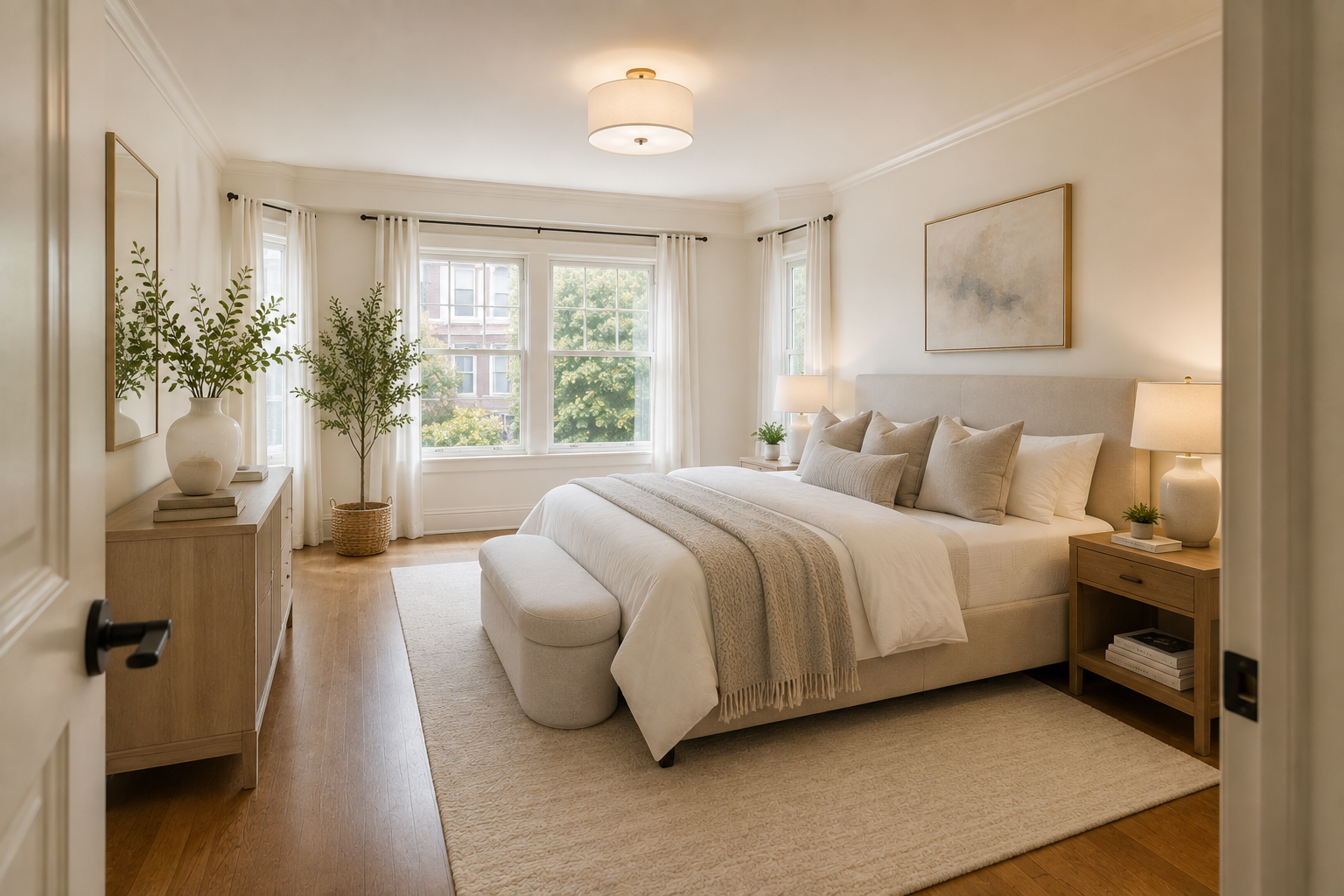
When buyers walk into a master suite, they are not just looking at a room — they are imagining a retreat. Applying the right bedroom staging tips master suite sellers use can be the difference between a quick offer and weeks of sitting on the market.
Key Takeaways
- A neutral color palette signals cleanliness and allows buyers to mentally move in faster.
- Symmetrical furniture layouts make the room feel intentional, spacious, and calming.
- Removing personal items such as family photos and clutter is one of the highest-impact steps you can take.
- Layered lighting — overhead, ambient, and task — transforms a flat-looking room into a warm, aspirational space.
- Small investments in bedding, pillows, and accessories can yield significant returns at closing.
- Professional staging consistently helps homes present stronger online, where most buyers see them first.
Why the Master Suite Has So Much Power Over Buyers
The master bedroom carries an outsized emotional weight in any home showing. It is one of the first rooms buyers mention when describing what they loved or hated about a property. If the space feels cramped, dark, or overly personal, buyers disconnect almost immediately, even if every other room in the home is pristine.
Real estate professionals consistently rank the master suite alongside the kitchen as one of the two rooms that most influence buying decisions. That is not because buyers expect perfection. It is because the master bedroom represents personal restoration — sleep, privacy, and a sense of calm that is hard to quantify but very easy to feel.
When the room is staged thoughtfully, buyers slow down. They linger. They start picturing where their own things would go. That emotional connection is exactly what leads to offers.
Setting the Foundation: Furniture Placement and Scale
One of the most common mistakes sellers make is leaving oversized or mismatched furniture in place simply because moving it feels like too much effort. The result is a room that feels tight, awkward, or unbalanced — none of which inspires a buyer to make an offer.
Start with the Bed as Your Anchor
In nearly every master suite, the bed should be centered on the primary wall, ideally opposite or perpendicular to the entrance. This gives the eye a clear focal point and creates a natural traffic flow around the room. If the bed is jammed into a corner or pushed against a wall to accommodate a dresser, the room immediately reads as small, even if it is not.
Recommended furniture placement principles:
- Allow at least 24 inches of walking clearance on each side of the bed.
- Remove any furniture that serves no obvious purpose in a staged bedroom — extra chairs, bulky armoires, or duplicate dressers.
- Use matching or coordinated nightstands on both sides of the bed to create symmetry.
- Keep dressers and wardrobes pushed against walls to maximize open floor space.
- Avoid rugs that are too small. A rug should extend at least 18 to 24 inches beyond each side of the bed frame.
If you want to see how these principles translate into real transformations, the before after section on BoldRM's website shows the impact of professional staging on actual listings.
Color, Light, and the Psychology of a Restful Space
Buyers respond to master bedrooms that feel calm and airy. That means color choices matter enormously, and the lighting you use to support those colors matters even more.
Choosing the Right Palette
Neutral tones dominate professionally staged master suites for a reason. Shades of warm white, soft greige, taupe, and light sage communicate cleanliness, spaciousness, and a blank-canvas quality that helps buyers project their own style onto the room. Bold accent walls or dark paint colors, while potentially attractive to the current owner, tend to narrow the buyer pool.
If repainting is not in the budget, you can shift the visual tone of the room significantly through bedding and soft furnishings. Crisp white or ivory duvet covers, layered with textured throws and accent pillows in muted tones, can neutralize even a strongly colored wall.
Lighting as a Staging Tool
Most bedrooms are underlit at the time of listing. Overhead fixtures provide flat, unflattering light that makes the room look smaller and less inviting. A well-staged master suite uses at least three layers of light:
- Ambient light: Overhead ceiling fixtures or recessed lighting to fill the room.
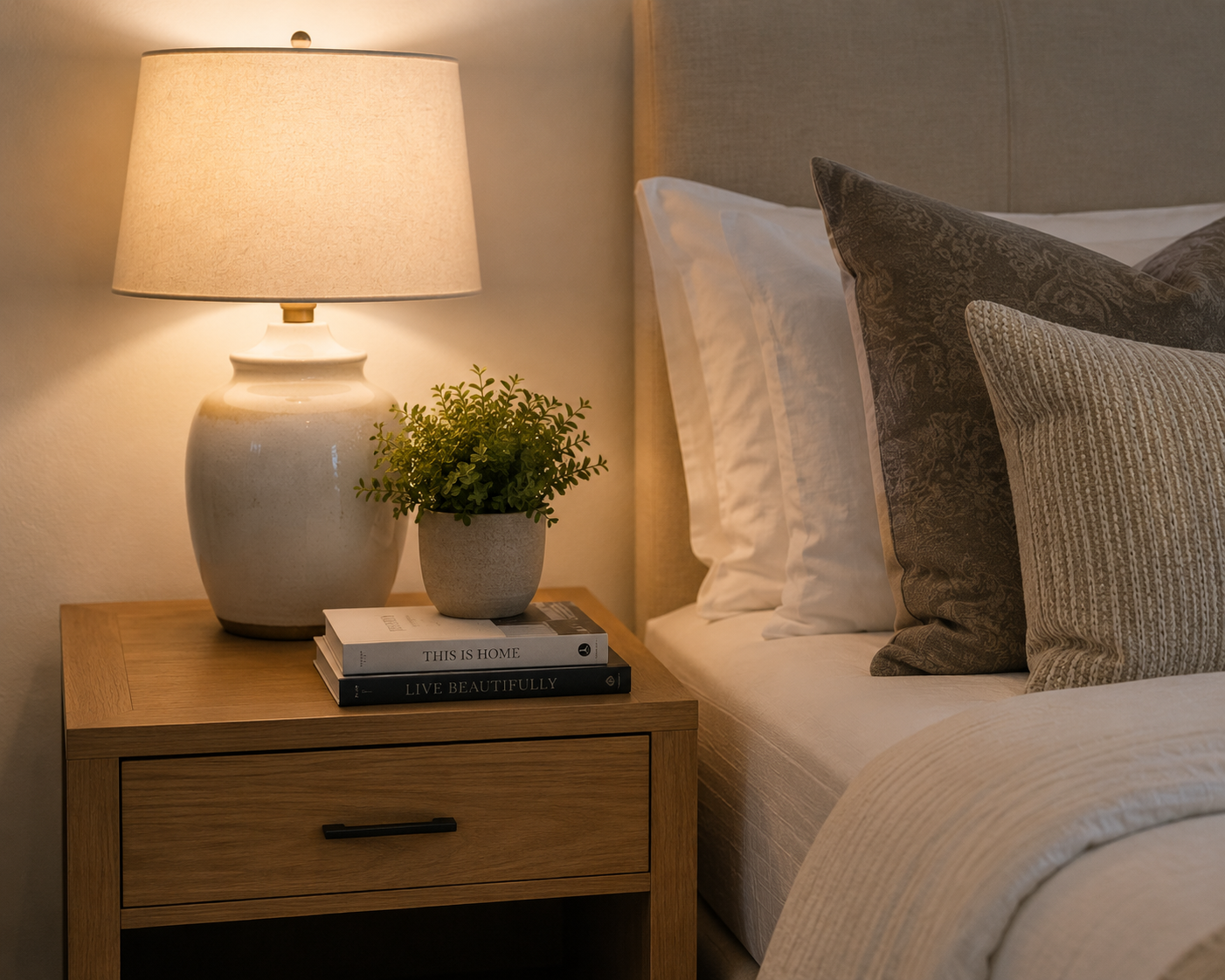
- Task light: Matching lamps on each nightstand, ideally with warm-toned bulbs (2700K to 3000K).
- Accent light: Subtle additions like a floor lamp in a corner or LED strips behind a headboard to add depth.
For showings and listing photography, every light source in the room should be on. Combine artificial light with natural light by opening curtains fully and cleaning windows inside and out.
Depersonalizing and Decluttering Without Stripping the Room Bare
Staging a master bedroom does not mean making it look like an empty hotel room. The goal is to create a space that feels aspirational — lived-in enough to feel warm, but neutral enough for buyers to see themselves there.
What to Remove
- Family photographs and personal memorabilia
- Medication, toiletries, or personal care products left on nightstands or dressers
- Excess throw pillows that look piled rather than styled
- Children's toys, pet beds, or anything that breaks the "retreat" atmosphere
- Overflowing closets (if closet doors open during a showing, they need to look organized)
What to Keep and Add
After removing personal items, the room can feel sparse. Fill that gap intentionally with a few well-chosen accessories:
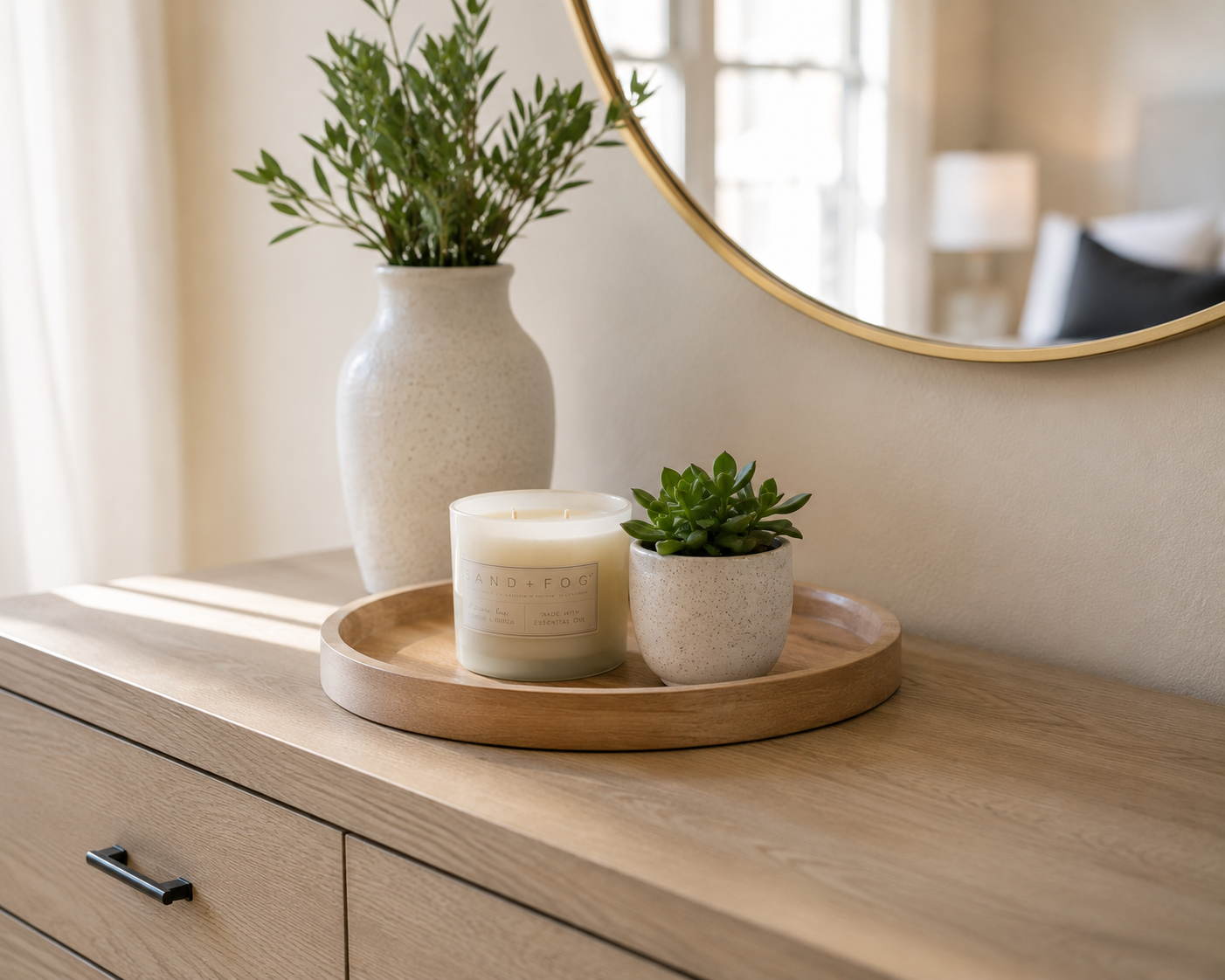
- A tray on the dresser with a candle, a small plant, and one decorative object
- A folded throw blanket draped naturally over the foot of the bed or over a chair
- Two matching lamps and simple framed art above the headboard or on the primary wall
- Fresh flowers or a small potted plant for a touch of organic warmth
If you are unsure where to start or how much staging investment makes sense for your specific property, you can contact us at BoldRM for a professional assessment.
Closets, En-Suite, and the Details That Buyers Notice
Buyers treat master suite closets and en-suite bathrooms as extensions of the bedroom itself. A beautifully staged bedroom loses credibility if the adjoining spaces feel chaotic or neglected.
Staging the Closet
Even a modest walk-in closet can look impressive if organized correctly. Remove at least half of the clothing currently hanging to create visual breathing room. Group items by type and color. Place matching hangers throughout. Clear bins on shelves look far tidier than random boxes.
For reach-in closets, pare down contents significantly and ensure the floor is clear. Buyers equate closet space with storage, so the more visible floor space you can show, the larger the closet reads.
En-Suite Bathroom Touch Points
- Replace worn or mismatched towels with a set of coordinated, hotel-style white or neutral towels.
- Remove all personal products from countertops and store them out of sight.
- Add one or two simple accessories — a small plant, a candle, a soap dispenser — to the vanity.
- Ensure grout is clean and caulk lines are fresh and white.
The services offered by BoldRM include occupied home staging consultations that cover exactly these kinds of details, room by room.
Staging for Photography vs. Staging for In-Person Showings
Most buyers in 2026 will see your home online before they ever step inside. That means listing photography is not a secondary consideration — it is the first showing. The bedroom staging tips master suite professionals apply are specifically designed to read well both on screen and in person.
For photography:
- Remove every item from nightstands that will not appear in the final styled shot.
- Steam or iron all bedding so it is completely wrinkle-free.
- Open all window treatments to maximize natural light.
- Remove ceiling fan blades if they create visual clutter in wide-angle shots.
For in-person showings:
- Add a light, pleasant scent through a candle or diffuser (avoid anything overpowering).
- Set the room temperature to a comfortable level before buyers arrive.
- Ensure all mirrors are spotless — they amplify light and make the room feel larger.
You can browse the BoldRM portfolio to see how professional staging photographs in real listing conditions.
Working with What You Have vs. Bringing in Staging Inventory
Sellers often assume that staging means renting furniture or starting from scratch. In reality, many master suites can be staged effectively using existing pieces, with only targeted additions or subtractions.
DIY Staging Checklist
- Assess your current furniture for scale and condition. Anything worn or out of proportion should be moved to storage.
- Invest in new bedding if your current set shows wear. A quality duvet cover and shams can cost as little as $80 to $150 and make an immediate visual impact.
- Replace any mismatched or overly decorative lamps with simple, matching pairs.
- Repaint if the current wall color is bold, dark, or divisive. A gallon of paint typically runs $30 to $60 and produces one of the highest return-on-investment updates in home preparation.
For sellers who prefer a professional eye, partial staging consultations allow you to work with a stager who assesses the room and provides specific recommendations without necessarily replacing all of your furniture.
To understand what staging might cost for your property and situation, you can use the staging calculator on BoldRM's website to get an instant estimate tailored to your home.
For additional ideas and inspiration throughout your staging process, the BoldRM blogs section covers a wide range of home preparation and staging topics you can explore at your own pace.
Regenerate section
The Bottom Line on Bedroom Staging Tips Master Suite
The master suite is one of the most emotionally significant spaces a buyer evaluates, and the bedroom staging tips master suite professionals rely on are not complicated. They are consistent, intentional, and grounded in how buyers actually experience a home.
Start with furniture scale and placement, then layer in neutral color, thoughtful lighting, and curated accessories. Depersonalize without stripping the room of warmth. Extend your attention to the closet and en-suite. And make sure every decision you make works both in person and in photographs.
If you want clarity on where to focus your budget and effort, take five minutes to use BoldRM's staging calculator. It is one of the fastest ways to understand your options and move forward with confidence.
Things to Know
- Buyers decide how they feel about a master suite within the first few seconds of entering, so the visual impression from the doorway is the most important angle to stage for.
- Natural light is one of the most powerful selling features a bedroom can have. If your windows are small or few, mirrors placed strategically across from them can double the perceived brightness of the space.
- Scent is often overlooked in staging, but it registers immediately. Avoid heavy candles or plug-in air fresheners during showings — a lightly diffused neutral scent or simply a clean, odor-free room performs best.
- The master bedroom closet is considered part of the suite by most buyers. An organized, spacious-feeling closet adds perceived value even when square footage has not changed.
- If you share the master bedroom with a partner who has a distinctly different style, the staging goal is to find a middle ground that appeals to the broadest audience, not to favor either person's taste.
- Listing photos are permanent. Once your home goes live online, those images define first impressions for every buyer who views the listing. Staging the room before the photographer arrives is non-negotiable.
Stop Losing Buyers at the Bedroom Door
Your master suite could be one of the strongest selling points in your home, but only if it is presented the right way. Buyers are making emotional decisions quickly, and a poorly staged room costs you offers, negotiating power, and time on the market.
Get your instant staging estimate through BoldRM's staging calculator and find out exactly what your home needs to compete. Take two minutes right now to enter your details and get a clear, personalized starting point.
Frequently Asked Questions
Q: What are some good tips for designing a master bedroom?
Focus on creating a calm, cohesive space that balances comfort with visual order.
Start by choosing a neutral color palette for walls and bedding, then build in layers of texture through throw blankets, accent pillows, and rugs. Prioritize furniture that is properly scaled to the room, ensure you have at least two sources of lighting beyond the ceiling fixture, and keep surfaces intentionally clear rather than densely decorated. The goal is a room that feels restful and purposeful at the same time.
Q: What are the must-haves for a master bedroom?
A well-scaled bed frame with quality bedding, matching nightstands, adequate lighting, and functional storage are the core essentials.
Beyond the basics, a master bedroom benefits from a full-length mirror, window treatments that provide both privacy and light control, and at least one comfortable seating option if space allows. From a staging perspective, the must-haves also include clean walls in a neutral tone, wrinkle-free linens, and a closet that reads as organized and spacious rather than stuffed. These elements communicate value immediately to a buyer walking through.
Q: How should a master bedroom look like?
A well-staged master bedroom should look calm, symmetrical, and aspirational — like a boutique hotel suite tailored to a broad audience.
The bed should be the clear focal point, centered on the dominant wall with balanced nightstands and lamps on each side. Surfaces should be clean and minimally styled, with just enough decor to add warmth without introducing clutter. Colors should read as cohesive rather than busy, and every element in the room should feel deliberate. When buyers walk in, the first impression should be one of comfort and possibility.
Q: What is the 3-5-7 rule in decorating?
The 3-5-7 rule is a design principle that guides how you group decorative objects on a surface or within a vignette, using odd numbers for visual balance.
The idea is that groupings of three, five, or seven items feel more natural and dynamic to the eye than even-numbered arrangements. In a master bedroom, this might mean styling a nightstand with three items — a lamp, a small plant, and a single book — or placing five decorative elements across a dresser top. Objects within each grouping should vary in height and scale to create visual interest. This principle is widely used in both interior design and home staging to make curated spaces feel organic rather than rigid.
Q: What are the trends for master bedrooms in 2026?
In 2026, master bedroom trends favor warm neutrals, natural materials, minimalist layouts, and a strong emphasis on wellness-oriented design.
Buyers and designers alike are gravitating toward organic textures such as linen bedding, rattan accents, and raw wood furniture rather than highly polished or synthetic finishes. Earthy tones — warm whites, clay, terracotta, and soft olive — are replacing the cooler grays that dominated previous years. There is also growing interest in dedicated wind-down zones within the suite itself, such as a reading nook or a small meditation corner, which speaks to a broader cultural shift toward treating the master bedroom as a restorative sanctuary rather than simply a place to sleep.
Where to Go From Here With Bedroom Staging Tips Master Suite
The path from a cluttered, overly personal bedroom to a buyer-ready master suite is more straightforward than most sellers expect. The bedroom staging tips master suite professionals apply consistently come back to the same core ideas: clear the space, balance the layout, warm up the lighting, and make the room feel like it belongs to the buyer rather than the seller.
Small, targeted changes yield real results. New bedding, a coat of neutral paint, paired lamps, and an organized closet can shift how buyers perceive not just the room, but the entire home. If you are ready to take the next step, visit BoldRM and use the staging calculator to get a clear picture of what your property needs and where to focus first.